




Hebrews 11:24-26, 32-40; John 1:43-51
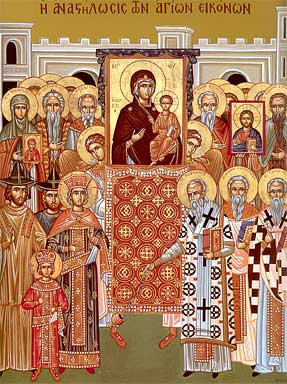
On this first Sunday of Great Lent, we commemorate the restoration of icons centuries ago in the Byzantine Empire. They were banned due to a misguided fear of idolatry but restored as a proclamation of how the entire creation, including every dimension of our personhood, may shine brightly with the gracious divine energies of our Lord. The icons convey the incarnation of the God-Man, Who is fully human with a real body, which was necessary for him to be born, live in this world, die, rise from the grave, and ascend into heaven. Were any aspect of His embodied humanity an illusion, we could not become “partakers of the divine nature” through Him. Icons of the Theotokos and the Saints display our calling to become radiant with holiness by uniting ourselves to Christ as whole persons, which requires healing the passions that lead us to abuse food, drink, money, sex, natural resources, and our neighbors.https://www.antiochian.org/regulararticle/616
Today’s commemoration shows that our Lenten journey is not about escaping from life in our bodies or in our world. Quite the opposite, the icons call us to find healing for every dimension of our personal and collective brokenness in the brilliant light of the Lord. The God-Man shares His salvation of the human person with us so that even our deepest struggles may become points of entrance into the blessedness of His Kingdom. During this season of Lent, we must pray, fast, give, forgive, and confess and repent of the ways in which we have refused to embrace our calling to become ever more beautiful living icons of Christ, which is necessary for us to gain the spirituality clarity to see that every human person bears the divine image as much as we do. If we are approaching this season with integrity, the ways in which we have fallen short of our high calling will quickly become apparent. The more we struggle against our slavery to self-centered desires, the more apparent their hold upon us will become. If you have been surprised during the first week of the Great Fast how your passions have reared their ugly heads, you are certainly not alone. If you have picked yourself up whenever you have fallen, gotten back on the path when you have strayed from it, and grown in your awareness of your need for the mercy of the Lord, then your Lenten journey is off to a good start. https://www.antiochian.org/dashboard?name=Great%20Lent
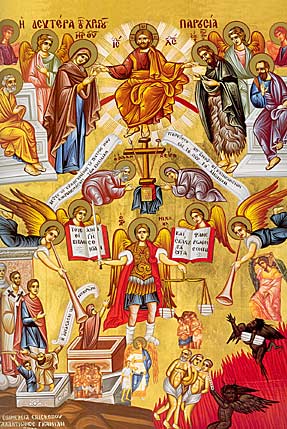
Above all, we must not despair in the face of our weakness because the goal is not merely to change our diets and become more religious. It is, instead, as the Savior said to Nathanael, nothing less than to “see heaven opened, and the angels of God ascending and descending upon the Son of man.” As those who bear the divine image and likeness, our calling is to share fully in the eternal life of the God-Man by grace. As we read in our epistle lesson, the Old Testament saints “did not receive the promise, since God had foreseen something better for us, that apart from us they should not be made perfect.” In Jesus Christ we have received the fulfillment of the ancient promise to Abraham as “partakers of the divine nature” who are called to be “perfect as your heavenly Father is perfect.” (Matt. 5:48) That is truly an eternal goal, but we participate already in a foretaste of such blessedness when we open our hearts to His healing through repentance. As Christ taught, “The Kingdom of God is within you.” (Lk. 17:21)
Even as the icons proclaim the truth of our Lord’s incarnation using materials like paint and wood, they call us to manifest His holiness in our own bodies. They remind us to make our daily physical actions tangible signs of Christ’s salvation. In fasting, we limit our self-indulgence in food in order to gain strength to purify and redirect our desires toward God and away from gratifying bodily pleasures. In almsgiving, we limit our trust in possessions in order to grow in love for our neighbors, in whom we encounter the Lord. In prayer, we limit our focus on our usual distractions to become more fully present to God as we open our hearts to Him. As experience teaches, even the smallest efforts to practice disciplines that open our hearts to receive Christ’s healing mercy reveal that there is so much within us that would rather remain in the darkness of corruption.
Nonetheless, our bodies are temples of the Holy Spirit and empowered to become radiant with the glory of our Lord’s resurrection. Literally no aspect of our humanity is excluded from the vocation to shine with God’s gracious divine energies. No matter how difficult the struggle with our passions may be, we must not become practical iconoclasts by refusing to become more beautiful living icons of Christ in any aspect of our existence. Instead, we must open even the darkest and most distorted dimensions of our lives to the healing light of Christ as we call out for His mercy from the depths of our hearts.
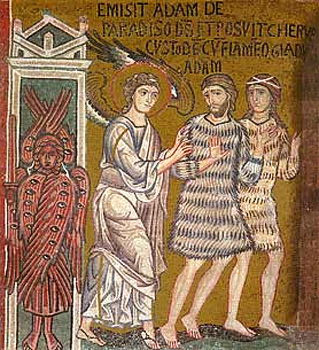
The Savior entered fully into death through His Cross in order to overcome the corruption of the first Adam. He rose and ascended in glory in order to make us radiant with His holiness. As we celebrate the historical restoration of icons today, let us continue the Lenten journey in ways that will enable us to be more fully restored as the beautiful living icons of God, for that is what it means to become truly human in the divine image and likeness. The disciplines of this season are not ends in themselves but simply present opportunities for us to become by His grace those who will “see heaven opened, and the angels of God ascending and descending upon the Son of man.” https://www.ancientfaith.com/podcasts/hopko/the_triumph_of_orthodoxy/

Leave a Reply