




Colossians 4:5-11, 14-18; Luke 10:16-21
We must be careful today to look for role models in the right places. Our culture celebrates many powerful, wealthy, and famous people whose lives provide examples we should definitely not follow. One of the many reasons that we remember the Saints in the Orthodox Church is because they are wonderful examples of what it looks like when human persons truly become like Christ. They shine brilliantly with holiness and inspire us to become like them as “partakers of the divine nature” by grace. The Saints comprise the great cloud of witnesses that encourages us to “run with endurance the race that is set before us” to the eternal joy of the Kingdom of Heaven. (Heb. 12:1)
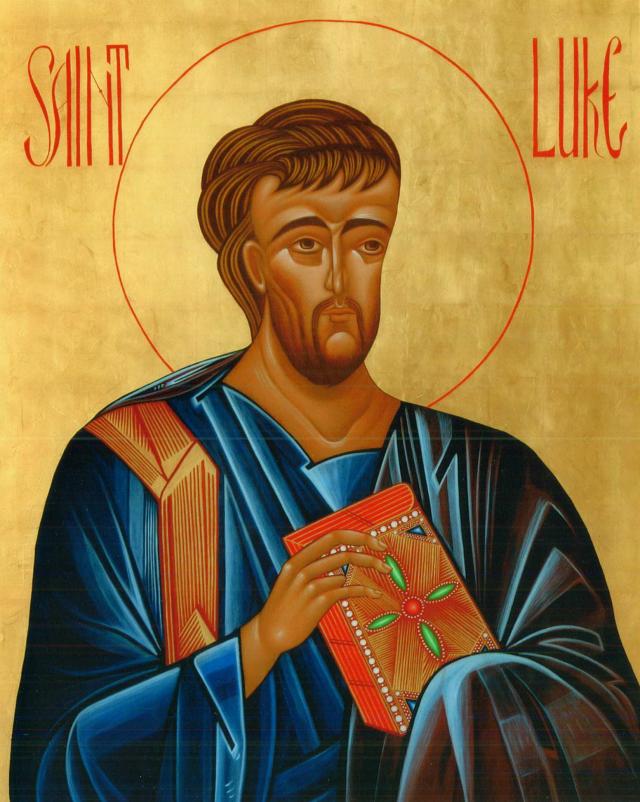
On this feast day of the Holy, Glorious, All-Laudable Apostle and Evangelist Luke, we have an opportunity to celebrate the great witness to the Lord made by the Patron Saint of our parish. Our small community is named in his honor and memory. We see his image on our iconostasis and regularly ask him to pray for us in the Divine Liturgy. Author of both a gospel and the Acts of the Apostles, as well as an iconographer and a physician, St. Luke died a martyr’s death at the age of 84.
One of the 70 Apostles sent out by the Lord to proclaim the good news, St. Luke was the only Gentile to write a canonized gospel. Like St. Matthew, he includes the family tree or genealogy of the Savior, but he traces the Lord’s lineage all the way back to Adam, the first human being who lived before the distinction between Jew and Gentile. By doing so, he showed that Christ came to bring all peoples and nations into the glory of His Kingdom. As a Gentile, St. Luke’s own heritage did not place him in the house of Israel, and his gospel especially emphasizes the mercy of Christ for those considered cut off from God’s blessings.
The Lord rejoiced in today’s gospel reading that the Father hid His truth from the wise and prudent, but revealed Himself to babes, to humble and simple people with little standing in the eyes of the world. Gentiles, the poor, the sick, and women got little respect in that time and place, but St. Luke presents the ministry of our Lord in a way that makes clear that the lowly and despised are often the ones most ready to receive the good news of Christ and enter into the joy of His Kingdom, precisely due to their humility.
For example, St. Luke tells us of the Virgin Mary’s obedient acceptance of the calling to become the Theotokos. She sings the Magnificat in response, praising God for regarding the low estate of His handmaiden; for henceforth all generations will call her blessed. A simple, unknown virgin girl miraculously became the living Temple of God; through her, the Savior came into the world. In humble obedience and with purity of heart, she freely accepted a shocking pregnancy that put her own life and reputation at risk. She sings of a God who has put down the mighty from their thrones, and exalted the lowly, who has filled the hungry with good things and sent the rich away empty.
The physician St. Luke describes the meeting between the pregnant Theotokos and the pregnant St. Elizabeth in which St. John the Forerunner leaped in the womb in the presence of the Savior. This very maternal scene coveys the vital importance of the role of women in the salvation of the world as well as the true humanity of Christ, Who has sanctified the womb. It is a remarkable scene that few men of that time, or perhaps of any time, would have recognized as being so spiritually profound.
St. Luke also writes of the astounding humility of Christ’s birth in a cave used as a barn, where the Son of God had the feeding trough of a farm animal for His crib. Shepherds—poor, dirty, and on the margins of society– were blessed as the first to hear of this event from the angels. In the Lord’s first sermon in St. Luke’s gospel, He read a text that showed His love for the weak, the outcasts, and the suffering. “The Spirit of the Lord is upon Me, because He anointed Me to preach the gospel to the poor…to heal the brokenhearted, to proclaim liberty to the captives, and recovery of sight to the blind, to set at liberty those who are oppressed, to proclaim the acceptable year of the Lord.” (Lk. 4:18-19) Those present in the synagogue that day liked the beginning of the sermon, but they hated the ending. For the Lord reminded them that God at times worked through the great Old Testament prophets Elijah and Elisha to bless Gentiles instead of Jews. When the people heard that, they literally tried to kill Christ by throwing Him off a cliff. They wanted a Savior to make them first in this world by bringing them power and glory, not One Who came to save even then those they viewed as worthless enemies.
St. Luke’s portrait of Christ demonstrates that His healing of the human person does not occur according to conventional social standards of who is important, powerful, or worthy. In contrast to those who equated holiness with popularity and privilege, the Savior taught that the last will often be first in the Kingdom of Heaven and the first will often be last. (Lk. 13:30) To this day, the persistent struggles of weak, humble, and lowly outcasts often prepare them to respond to Christ with great joy. In contrast, those addicted to their possessions, power, and social standing so easily entrust themselves to the things of this world and risk losing their own souls. That was an uncomfortable and even dangerous message to proclaim in first-century Palestine, and it remains so in our time and place.
Even with so many being drawn to the Church today, ours remains a small, obscure parish in a region with very few Orthodox Christians. St. Luke is an especially appropriate Patron Saint for us since, like the common people he described, our community has no special prominence or standing at all. There is no common ethnicity or other human characteristic holding us together. To put it bluntly, there is no earthly reason for our parish even to exist. Our life together is a sign of nothing but God’s abundant grace and mercy for a very unlikely collection of people.
St. Luke described the original Christian community in similar ways in the Acts of the Apostles. By the power of the Holy Spirit at Pentecost, people who spoke different languages were united together as the Body of Christ. Both Jews and Romans persecuted them. There were tensions in the Church between different ethnic and cultural groups. Arguments raged over whether Gentiles had to be circumcised and obey the Jewish law before becoming Christians. The Church as described by St. Luke was not wealthy, well-known, or powerful. To follow Jesus Christ under those conditions was a difficult struggle. In their weakness, however, the first Christians found God’s strength. In their humility, they were lifted up by His power. In their obedience, they became victors over their enemies by sharing in Christ’s triumph over sin and death in their own lives.
Let us celebrate our patronal feast by persisting in obedience to the Lord for Whom St. Luke gave his life, both throughout his long and varied ministry and as a martyr. That means taking up the cross of being strangers to the proud ways of the world so that we may acquire the humble purity of heart necessary to experience the blessedness of the Kingdom. To do so, we must offer our time, talents, and resources for the flourishing of our parish as a sign that the world’s healing does not come through the acclaim of the high and mighty, but through the faithfulness of meek and obscure people who together are being transformed by the Lord’s mercy into living icons of a reign that stands in sharp tension with the conventional ways of the world. St. Luke is our role model in pursuing such a life together, not according to what is popular, easy, or widely celebrated, but as a sign that in Jesus Christ the ancient promises to Abraham are fulfilled and extended to all who bear the divine image and likeness. Let us ask for the prayers of our Patron Saint even as we follow his example in continuing to run “with endurance the race that is set before us…” (Heb. 12:1) We could not ask for a better role model.

Leave a Reply