




Ephesians 4:1-17; Luke 12:16-21
Having begun the Nativity Fast on November 15 in preparation to welcome the Savior at Christmas, today we continue celebrating the Feast of the Entrance of the Most Holy Theotokos into the Temple. Her elderly parents Joachim and Anna offered Mary to God by taking her to live in the Temple in Jerusalem as a young girl, where she grew up in prayer and purity as she prepared to become the Living Temple of the Lord in a unique and extraordinary way as His Virgin Mother. This feast directs us to the good news of Christmas, as it is the first step in Mary’s life in becoming the Theotokos who gave birth to the Son of God for our salvation. She is the epitome of our cooperation or synergy with God, for she freely chose to say “Yes” to the Lord with every ounce of her being.
Joachim and Anna had a long and difficult period of preparation to become parents, as they had been unable to have children for decades until God miraculously blessed them in old age to conceive. They knew that their daughter was a blessing not simply for the happiness of their family, but for playing her part in fulfilling God’s purposes for the salvation of the world. Their patient faithfulness throughout their years of barrenness helped them gain the spiritual clarity to offer her to the Lord. They foreshadowed the proclamation in the Divine Liturgy: “Thine Own of Thine Own, we offer unto Thee on behalf of all and for all.”
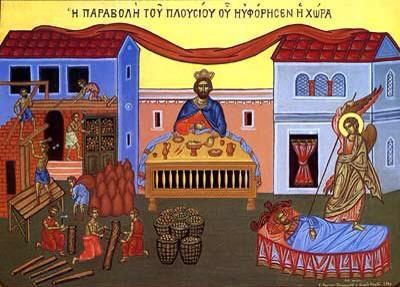
Joachim, Anna, and the Theotokos are the complete opposites of the rich man in today’s gospel lesson who exemplifies the way of life that is so appealing and popular in our world of corruption. His only concern was to eat, drink, and enjoy himself because he had become so wealthy. Self-centered love was so deeply ingrained in his character that he cared only for possessions, pleasure, and success. He saw the meaning and purpose of his life exclusively in those terms. When God required his soul, however, the man’s true poverty was revealed, for the accomplishments of this life inevitably pass away and cannot save us. As we read in the Psalms (48/49), “Do not become afraid when one becomes rich, when the glory of his house increases. For when he dies, he will carry nothing away; his glory will not go down after him.”
This man’s horizons extended no further than his dreams of the large barns he planned to build to hold his crops. Before the ultimate judgment of God, he was revealed to be a fool who had wasted his life on what could never truly heal or fulfill one who bore the divine image and likeness. He had laid up treasure for himself but was not rich toward God in any way. The problem was not simply that the man had possessions, but that he had made them his god, which is another way of saying that he worshipped only himself and surely was not concerned about the needs of his neighbors. His barns were a temple of the greed to which he had offered his entire existence in a vain effort to satisfy his self-centered desires. He would have done much better to have heeded the advice of St. Paul that wealthy people must not “trust in uncertain riches but in the living God, who gives us richly all things to enjoy. Let them do good, that they be rich in good works, ready to give, willing to share, storing up for themselves a good foundation for the time to come, that they may lay hold on eternal life.” (1 Tim. 6: 17-19)
The Theotokos, in contrast, followed the righteous example of her parents and focused on the one thing needful of hearing and obeying the Word of God. That is how she gained the spiritual strength to agree freely to become our Lord’s mother, even though she was an unmarried virgin who did not understand how such a thing could happen. When she said, “Behold the handmaid of the Lord; let it be to me according to your word,” she bravely made a whole, complete offering of her life to God. She was not focused on gaining money, power, or any kind of earthly success. She did not worship any of the false gods of this world. Unlike the rich fool in the parable, she was not blinded by passion and had the purity of soul to put receptivity and obedience to the Lord before all else. That is how she became the Living Temple of the Lord and the greatest example of what it means to unite ourselves to Christ in holiness.
The Nativity Fast calls us to follow the Theotokos in becoming holy temples of the Lord as we find healing from the passions that keep us from being “rich toward God.” Even small steps in restraining our appetites and investing ourselves in prayer and generosity help us gain the spiritual strength necessary to share more fully in the gracious life of our Lord. They help us find liberation from the paralysis of self-centeredness so that we may obey the Apostle’s advice to the Ephesians “to lead a life worthy of the calling to which you have been called, with all lowliness and meekness, with patience, forbearing one another in love, eager to maintain the unity of the Spirit in the bond of peace.” If, instead, we follow the way of the rich fool, we will become so weakened by diseases of soul that we will find it impossible to become persons united in a communion of love in the Church, our families, or anywhere else. That is a path that leads only to division, isolation, and bitter regret.
The Theotokos entered the Temple, living there for years in preparation to become the Son of God’s Living Temple through whom He took on flesh. The Nativity Fast provides us blessed opportunities to become more like the righteous young woman who said “Yes” to God definitively and without reservation of any kind. It calls us to become more like Joachim and Anna in the patient trust in God that enabled them to offer their long-awaited daughter to Him. They show us how to enter the heavenly temple by embracing the difficult struggle of learning to offer ourselves and our blessings fully to the Lord. Like it or not, our lives are temples to one thing or another. We will offer our time, energy, attention, and resources to something or someone. Instead of becoming fools who give our lives to that which cannot satisfy or save us, this season calls us to follow in the way of the Theotokos and her holy parents.
Their choices were of crucial importance for their own salvation and for that of the entire world. As hard as it is to believe, the same thing is true of us. We are unique persons with unique responsibilities, resources, and relationships that only we can offer to God as points of entrance into the blessedness of the kingdom. Our bodies are temples of the Holy Spirit, and we must embrace the struggle to offer literally ever dimension of our lives in this world for healing and transformation. We must hold nothing back. That is the only way truly to prepare to welcome the Savior into our lives at His Nativity as the God-Man.
To do so, we must keep a daily rule of prayer as an essential foundation of becoming “rich toward God.” That means regularly opening our hearts to the Lord instead of giving them to the passing things of this world. The Holy Spirit is present everywhere and fills all things, but we must mindfully embrace the struggle to become fully present to Him as we offer our time and attention. We will grow as holy temples of the Lord by praying consistently in ways appropriate to our spiritual maturity and life circumstances, regardless of whether we feel like doing so at the moment. The same is true of fasting and almsgiving, which both provide opportunities to find healing from our passions as we refuse to gratify our self-centered desires, even if in only small ways. A simple diet also frees up resources to share with needy neighbors in whom we encounter and serve Christ. The more that we open ourselves to receive our Lord’s healing strength through prayer, fasting, and generosity, the more able we will be to imitate the Theotokos in becoming fully receptive to the Savior as whole embodied persons. The more that we become like her, the better prepared we will be to celebrate the glorious news of Christmas that the Son of God has truly become one of us in order to make us participants in His healing and fulfillment of the human person in the divine image and likeness. If doing so is our focus during these coming weeks, then we will gain the spiritual clarity to celebrate His Nativity as our entrance into nothing less than eternal life.

Leave a Reply